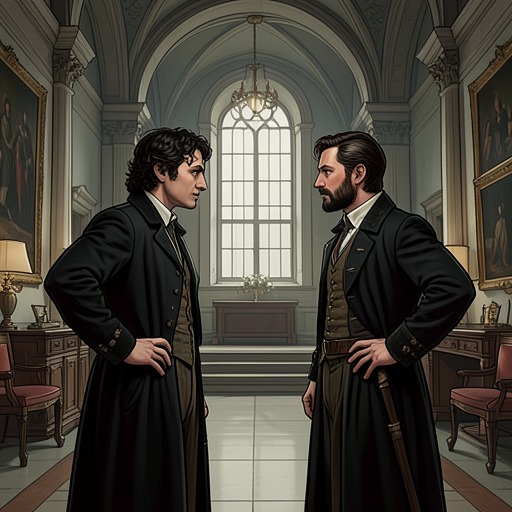
The Quarrel at Thrushcross Grange
Wuthering HeightsThe Quarrel at Thrushcross Grange is the explosive confrontation that destroys the precarious equilibrium of Catherine Earnshaw's married life, forcing her to choose between her husband, Edgar Linton, and the man she declares to be her very being, Heathcliff. The scene crystallizes the novel's central conflict—the irreconcilable tension between civilized domesticity and wild, elemental passion—and its consequences ripple outward, triggering Catherine's fatal illness, Heathcliff's escalating revenge, and the eventual ruin of both households. It is the moment when Edgar Linton, the gentle master of Thrushcross Grange, finally asserts his authority, and Heathcliff, the vengeful outsider, is violently expelled, leaving Catherine to face the emotional wreckage alone.
Causes and Background
The quarrel erupts from a volatile mixture of long-simmering resentments and a specific provocation. Heathcliff, having returned to the neighborhood wealthy and determined on revenge, has been a tolerated, if unwelcome, presence at Thrushcross Grange, admitted only because Catherine wishes to maintain the acquaintance. Edgar Linton, though aware of Heathcliff's "miserable, degraded character," has acquiesced to his wife's wishes, foolishly, as he later admits, believing Heathcliff only partly responsible for his own baseness. The immediate spark is Heathcliff's outrageous talk, which Edgar overhears while listening at the door—language so offensive that it prompts him to confront his wife about her continued association with such a man. Catherine, rather than defending herself, responds with a tone calculated to provoke her husband, implying carelessness and contempt for his irritation, while Heathcliff sneers, deliberately drawing Edgar's attention and escalating the tension.
The Confrontation
Edgar Linton, his patience exhausted, delivers an ultimatum: Heathcliff's presence is "a moral poison that would contaminate the most virtuous," and he demands his instant departure, warning that three minutes' delay will render it "involuntary and ignominious." Heathcliff responds with derision, measuring Edgar with an eye full of contempt and mocking him as a "lamb" that threatens like a bull, expressing regret that Linton is "not worth knocking down." When Edgar signals for the servants, Catherine intervenes dramatically, locking the door and throwing the key into the hottest part of the fire, declaring that if her husband lacks the courage to attack Heathcliff, he should apologize or allow himself to be beaten. Edgar, overwhelmed by mingled anguish and humiliation, leans on a chair and covers his face, his nervous trembling and deadly pallor betraying his complete emotional collapse. Catherine, far from sympathizing, taunts him mercilessly, comparing him to a "sucking leveret" and wishing Heathcliff might flog him sick. Heathcliff, seizing the advantage, pushes the chair on which Edgar rests, and Edgar, springing erect, strikes him full on the throat with a blow that would have leveled a slighter man. Heathcliff, choking, vows to crush Edgar's ribs "like a rotten hazel-nut" before crossing the threshold, but when the gardeners and coachman arrive with bludgeons, he seizes the poker, smashes the lock from the inner door, and escapes as they tramp in.
Catherine's Breakdown
In the aftermath, Catherine, nearly distracted, throws herself on a sofa and confesses to Ellen Dean that a thousand smiths' hammers are beating in her head. She blames Isabella Linton for the uproar, insisting that Heathcliff's talk was outrageous but that she could have diverted him from her sister-in-law, and that "the rest meant nothing." She asks Ellen to tell Edgar she is in danger of being seriously ill, admitting she wants to frighten him, and that she is certain she should recriminate if he begins a string of abuse. When Edgar, persisting, demands she choose between him and Heathcliff, Catherine flies into a senseless, wicked rage, ringing the bell till it breaks, dashing her head against the arm of the sofa, and grinding her teeth. She stretches herself out stiff, turns up her eyes, and assumes the aspect of death, her cheeks blanched and livid, with blood on her lips. Edgar, terrified, stands looking at her in sudden compunction and fear, while Ellen, though afraid in her heart, whispers that there is nothing in the world the matter, not wanting him to yield.
Consequences and Aftermath
The quarrel marks the beginning of Catherine's decline. Her violent emotional collapse, the blood on her lips, and her subsequent illness—the brain fever that eventually kills her—all trace their origin to this confrontation. Heathcliff, expelled from Thrushcross Grange, is barred from seeing Catherine again, a separation that fuels his monomaniacal grief and his determination to possess everything Edgar holds dear. The scene also exposes the fundamental incompatibility of Catherine's two loves: her love for Edgar, which she compares to foliage that time will change, and her love for Heathcliff, which she insists resembles the eternal rocks beneath, declaring, "I am Heathcliff!" The quarrel forces her to articulate this division, and its impossibility destroys her. Edgar, humiliated and wounded, retreats into a cold, protective distance, while Heathcliff, nursing the blow in his gullet, begins the systematic campaign of revenge that will see him seize Wuthering Heights, manipulate the younger generation, and ultimately reduce both families to ruin.
Narrative Role and Significance
The quarrel functions as the novel's central turning point, the moment when the two male rivals for Catherine's heart collide with devastating force. It is narrated by Ellen Dean to Mr. Lockwood, and her account is colored by her own judgments—her impatience with Catherine's folly, her fear of Heathcliff's violence, her loyalty to Edgar. The scene's intensity derives from its compression of the novel's core themes: the clash between nature and civilization, the destructive power of possessive love, and the impossibility of reconciling the demands of the heart with the conventions of society. Heathcliff's escape through the smashed lock prefigures his later invasions of the Grange, while Catherine's collapse foreshadows her death. The quarrel also establishes the pattern of Heathcliff's revenge: he will not strike Edgar directly but will systematically dismantle everything Edgar loves, using the law, property, and the next generation as his instruments. The scene's echoes persist to the novel's end, when Heathcliff, dying, is found with his eyes fixed in a "frightful, life-like gaze of exultation," and the country folk swear he walks the moors with Catherine's ghost—a haunting that began with the quarrel that tore them apart.